Summer STR Performance Review: Strong RevPAR Growth Masks Diverging Market Trends
Key Data Dashboard
9/7/2026
Sponsored by Key Data Dashboard
As the 2026 summer travel season draws to a close, the short-term rental industry has largely delivered on the expectations that emerged earlier this spring. When we reviewed summer pacing in May, we noted that operators were entering the season amid continued economic uncertainty, elevated borrowing costs, persistent geopolitical tensions, and increasingly cautious consumer spending. Rather than relying on a surge in travel demand, we anticipated that many destinations would lean on pricing power to drive revenue growth, with compressed booking windows and more selective consumer behavior shaping the summer landscape.
Three months later, those expectations have largely been realized.
Across many of the nation’s leading vacation markets, revenue growth remained healthy despite a more normalized travel environment. The sources of that growth, however, varied considerably by destination. In markets such as Cape Cod and St. Augustine, higher rates accounted for most of the improvement, while Ocean City, Hawaii, and several other destinations benefited more meaningfully from stronger occupancy. Other markets, including Jackson Hole and San Diego, delivered a healthier combination of demand and pricing growth. The result was broad-based RevPAR improvement without a single growth pattern defining the entire summer.
To illustrate how the season ultimately unfolded, the accompanying chart compares paid occupancy, ADR, and RevPAR alongside their year-over-year summer (June through August) performance across the same major markets featured in our preseason outlook. Rather than focusing on pacing, the comparison highlights which destinations generated growth through stronger demand, which relied primarily on pricing power, and where overall revenue performance exceeded expectations.
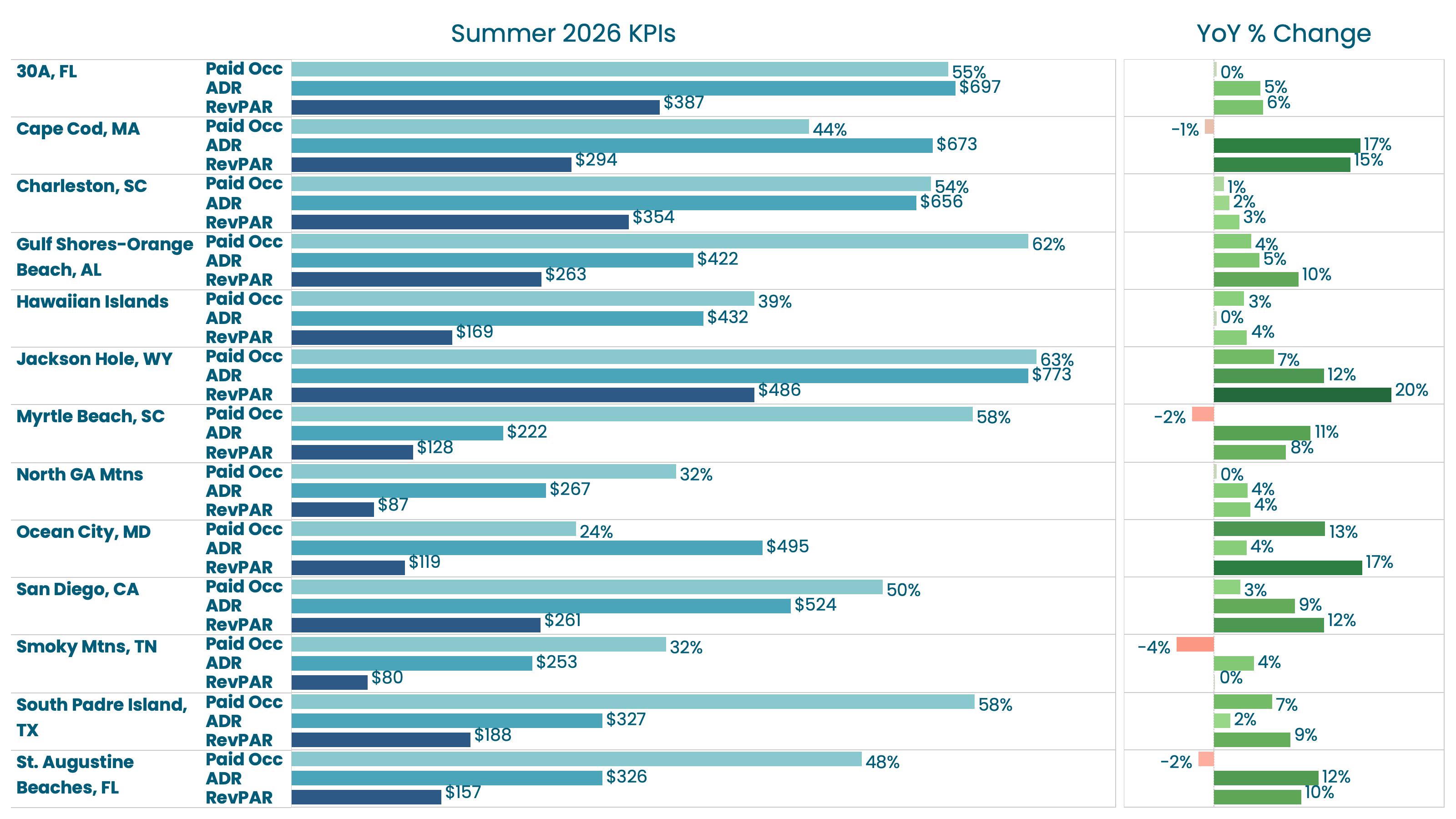
One of the clearest themes emerging from the data is the diversity of the growth drivers across markets. Occupancy changes were relatively modest in many destinations, but several markets experienced meaningful demand gains, while others relied much more heavily on ADR growth. In some cases, stronger pricing offset softer occupancy; in others, improving demand allowed operators to generate revenue growth without substantial rate increases. Despite those differences, RevPAR remained positive across most of the markets analyzed, pointing to a generally resilient summer season.
Cape Cod, Massachusetts, once again emerged as one of the strongest performers of the summer. Although paid occupancy slipped slightly compared to last year, ADR increased by 17%, driving RevPAR growth of more than 15%. The market demonstrated that exceptional seasonal demand and limited high-quality inventory continue to provide operators with significant pricing power. Rather than chasing occupancy, property managers successfully maintained premium nightly rates throughout the season, allowing revenue performance to accelerate despite relatively stable demand.
Jackson Hole, Wyoming, delivered another exceptional summer, confirming its position among the industry’s strongest luxury destinations. Paid occupancy increased 7% year over year while ADR climbed more than 12%, resulting in RevPAR growth exceeding 20%. The market continues to benefit from affluent travelers who remain comparatively insulated from broader economic pressures, allowing operators to pair healthy demand with substantial pricing gains. The performance reinforces a trend that has become increasingly evident over the past several years: premium experiential destinations continue to outperform more price-sensitive vacation markets.
Ocean City, Maryland, also stood out as one of the summer’s biggest success stories. Unlike many markets where pricing accounted for most revenue growth, Ocean City benefited from meaningful improvements in both occupancy and ADR. Double-digit occupancy gains combined with continued rate growth produced one of the strongest RevPAR increases across the dataset, suggesting that demand remained exceptionally healthy throughout the peak travel season. The market exceeded the optimistic pacing seen in May and finished the summer as one of the year’s strongest performers.
San Diego, California, similarly posted a balanced performance, combining healthy occupancy gains with nearly double-digit ADR growth. Rather than relying exclusively on pricing, the market benefited from both stronger traveler demand and continued willingness among guests to absorb higher nightly rates. The result was another year of double-digit RevPAR growth, reinforcing the resilience of premium coastal destinations with diverse leisure demand.
Several additional leisure markets quietly delivered solid summers, although the sources of their growth varied. Gulf Shores and Orange Beach benefited from improvements in both occupancy and pricing, while South Padre Island saw demand play a meaningful role in its performance. St. Augustine Beaches followed a different pattern: ADR increased nearly 12% even as paid occupancy declined roughly 2%, allowing RevPAR to rise nearly 10%. Together, these markets demonstrate that there was no single formula for growth this summer.
Hawaii provides one of the clearest examples of demand rather than pricing driving summer growth. ADR remained essentially unchanged from last year, increasing just 0.3%, while paid occupancy improved 3.4%. That occupancy gain pushed RevPAR nearly 4% higher. Hawaii therefore contrasts sharply with destinations such as Cape Cod and St. Augustine, where rate increases accounted for most of the revenue improvement.
However, not every market experienced the same level of momentum. The Smoky Mountains in Tennessee, for example, faced a more challenging summer. Occupancy declined year over year, and while ADR increased by roughly 4%, the additional pricing was only enough to keep RevPAR essentially flat. The market appears to be continuing its normalization following several years of extraordinary pandemic-era demand, with softer booking activity limiting overall revenue growth despite disciplined pricing.
The North Georgia Mountains experienced a more subdued summer as well, although the underlying dynamics differed somewhat from the Smoky Mountains. Paid occupancy was essentially flat year over year, while ADR increased nearly 4%. That modest pricing growth allowed RevPAR to rise just over 4%, producing positive but comparatively restrained revenue gains. The market’s performance reflects a more normalized demand environment in which operators were able to generate incremental growth primarily through rate rather than additional occupancy.
Perhaps one of the biggest surprises of the summer was Myrtle Beach, South Carolina. During the preseason, the market appeared poised for one of the weakest performances among major leisure destinations as booking pace lagged last year’s levels. While occupancy ultimately finished slightly below last summer at this point, operators successfully pushed ADR more than 10% higher, allowing RevPAR to increase by more than 8%. Although demand remained somewhat softer than many competing beach markets, pricing strength proved sufficient to produce a far stronger outcome than early-season pacing suggested.
Charleston, South Carolina, followed a similar trajectory. In May, the market appeared to be losing momentum as occupancy lagged behind previous-year levels. By early August, however, much of that weakness had moderated. Occupancy is poised to finish modestly ahead of last year, ADR continued to increase, and RevPAR ultimately posted positive growth. While Charleston did not experience the outsized gains seen in several coastal resort markets, the market nevertheless outperformed its preseason trajectory and demonstrated the resilience of high-quality urban-adjacent leisure destinations.
More broadly, the summer reinforced how differently individual destinations are now behaving within a more mature short-term rental environment. Booking windows remained compressed compared with historical norms, while consumers continued to demonstrate greater selectivity in their travel decisions. Some premium experiential markets retained considerable pricing power, but stronger occupancy also played an important role in several coastal and leisure destinations. Rather than moving together, markets increasingly appear to be responding to their own combinations of supply, traveler demographics, accessibility, and pricing dynamics.
The season also highlighted the growing importance of market-specific revenue management. In destinations where demand remained strong, operators were able to capture additional occupancy without sacrificing rate. Elsewhere, managers successfully used higher ADRs to offset flat or declining occupancy. The varying outcomes reinforce the importance of responding to local demand conditions rather than pursuing either occupancy or rate growth in isolation.
Overall, the 2026 summer season can be characterized as resilient but considerably more nuanced than a single industrywide trend would suggest. The rate strength anticipated in May did materialize in several important destinations, but stronger-than-expected occupancy also became a meaningful contributor to performance in markets such as Ocean City and Hawaii. Luxury and experiential destinations generally remained strong, while several markets that appeared vulnerable during the spring ultimately improved as late-booking demand materialized. Most importantly, the summer demonstrated that healthy RevPAR growth can emerge through very different combinations of occupancy and pricing, and that understanding those market-specific dynamics is becoming increasingly important as the short-term rental industry matures.
If you’re interested in a custom market report, click here to request one.