The Next Wave of Vacation Rental M&A
Jacobie Olin and Dylan Burgess
8/17/2026
Sponsored by C2G Advisors
Earlier this year, we hosted our first “Ask Us Anything” webinar, and the response told us everything we needed to know about where owners’ heads are right now. Hundreds of vacation rental managers turned up with the same underlying question, asked a dozen different ways: After the whiplash of the last few years, what is my business actually worth today, and what should I be doing about it?
We received far more questions than we could answer live, so this article distills the most important themes in one place: where the market stands, what genuinely drives value, and the concrete steps that separate a premium outcome from a disappointing one.
The Bottom Is In
For two years, the short-term rental M&A market lived under a cloud. Inflated 2021-era expectations collided with softening average daily rates, rising labor and insurance costs, and interest rates that made buyers cautious. Deals slowed. Owners waited.
That period is over. Deal activity rebounded sharply across 2025, and more telling than the volume, the profile of the buyers changed. Institutional capital has returned in force, and it is reshaping the industry from the top down. Consider what the past 18 months have brought:
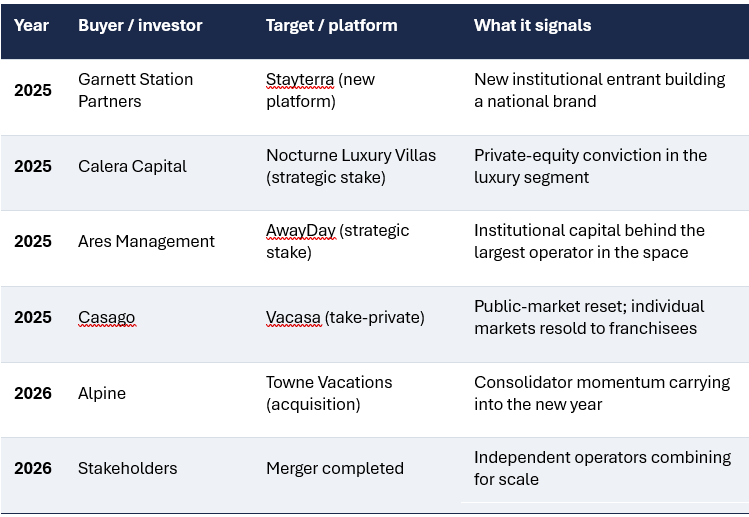
Alongside these headline transactions, roughly 50 additional deals closed across the United States over the same period, which is evidence that activity runs far deeper than the marquee names. The common thread is unmistakable: Capital allocators are treating vacation rental management as an institutional asset class. We believe the next three to five years will bring the most compelling M&A cycle this industry has ever seen.
The Scarcity Equation
To understand why this cycle favors quality sellers, start with simple supply and demand. There are roughly 30,000 professional property managers in the United States, but the average manager earns only about $6,000 of profit per property, so real earnings require real scale. Only about 300 companies, roughly 1% of the industry, operate portfolios of more than 300 properties. Of those, approximately 200 remain independently owned, which means there are only around 200 vacation rental managers in the country generating $2 million or more of annual profit. And in any given year, just three to five of them actually come to market.
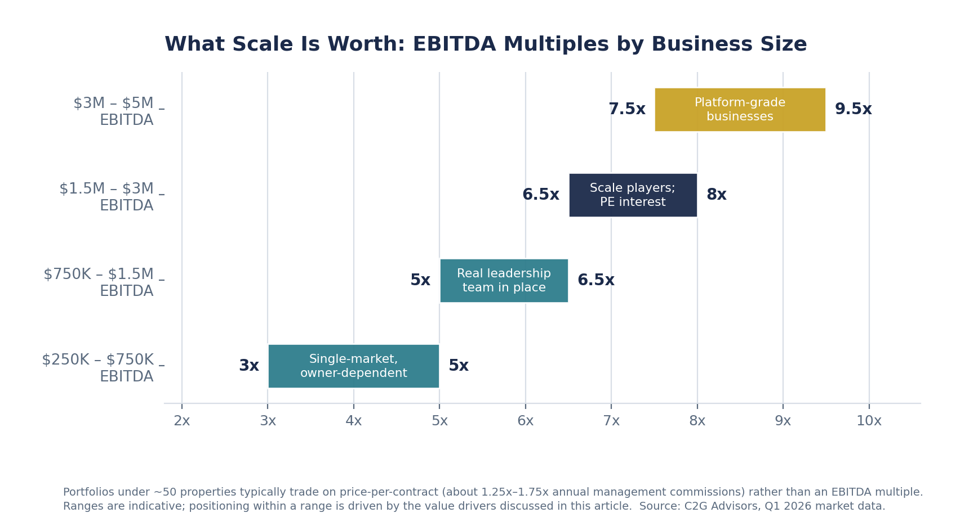
On the other side of the table sits a deep bench of strategic acquirers, private equity–backed consolidators, and independent sponsors, all competing for the same short list of opportunities. When a genuinely scalable, professionally run business becomes available, buyers know another may not appear for months. That scarcity is what produces aggressive multiples, competitive bidding, and real leverage for sellers. If you have built something at scale, the math is working for you.
What Actually Drives Your Multiple
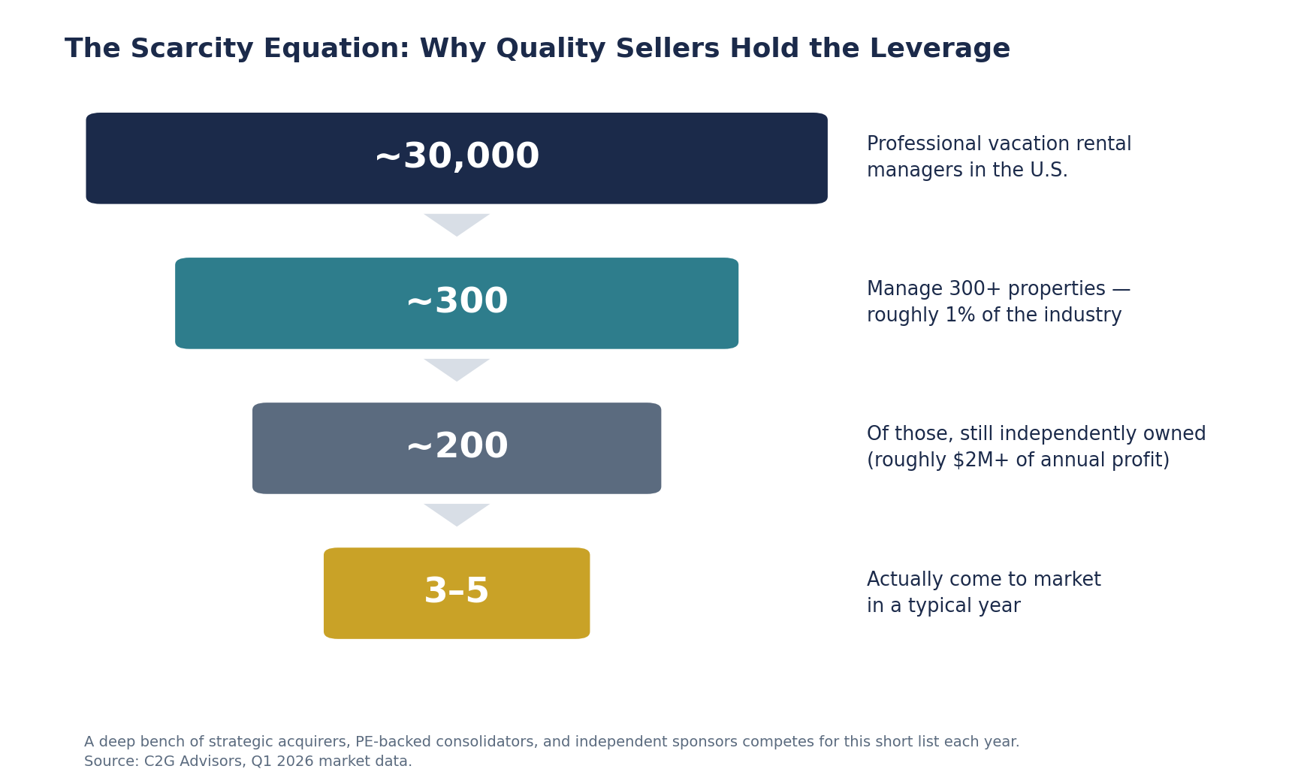
Owners often assume the multiple is a fixed number tied to size. In reality it is a moving target shaped by two forces: risk and growth. Size sets the range; risk and growth determine where you land within it or above it.
What Buyers Mean by “Adjusted EBITDA”
EBITDA is earnings before interest, taxes, depreciation, and amortization—a proxy for the cash flow the business generates. Buyers work from adjusted EBITDA: reported earnings normalized for one-time expenses, above or below market owner compensation, personal expenses run through the business, and anything else that will not continue under new ownership.
This is why two companies with identical top-line revenue can be worth very different amounts and why clean, verifiable financials are the foundation of every premium valuation.
Where you land within those ranges comes down to a handful of value drivers buyers underwrite again and again:
- Financial hygiene. Accurate, reconciled, professionally maintained financials—the single biggest credibility signal you can send.
- Revenue diversification. Ancillary fees, direct-booking share, and technology fees that lift net margin beyond the base management commission.
- Owner retention. Above 90% is strong; below 80% is a red flag that inventory may walk out the door after closing.
- Management team depth. The difference between key-person risk and institutional-grade operations that run without the founder.
- Market quality and unit mix. Desirable geographies and high gross booking value per property.
- Growth trajectory. Unit count, pacing, and revenue all trending up including how the current peak season compares with prior years.
- Homeowner agreement quality. Term length, auto-renewal, exclusivity, and assignability. Open-ended agreements that let owners leave on thirty days’ notice are a real valuation risk.
The Gaps That Quietly Cost You
If value drivers are what earn a premium, diligence gaps are what erode it and the most common ones are entirely preventable. Messy, owner-prepared financials that don’t reconcile top the list; nothing spooks a buyer faster. Close behind are high homeowner concentration (a single owner controlling 15% or more of inventory), non-assignable management agreements, and heavy founder involvement with no second layer of management. Any one of these can translate into a lower multiple, a larger holdback, or a longer earnout. Left unaddressed, they can collapse a deal entirely.
How Deals Actually Get Structured
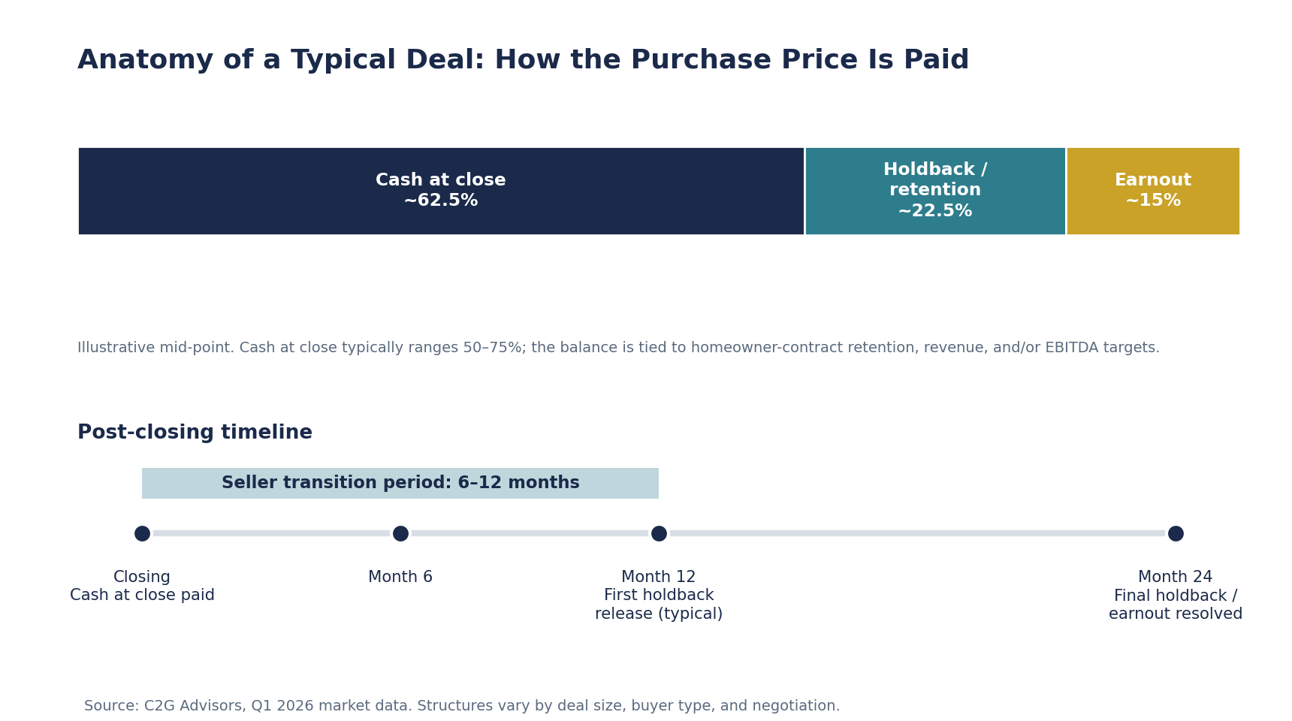
Very few transactions are all cash at closing, and understanding that early prevents disappointment later. Buyers typically pay 50%–75% of the purchase price in cash at close, with the balance paid over the following 12–24 months contingent on how the business performs after the sale. Sellers should also plan to stay involved through a 6- to 12-month transition.
Deal Terms, Translated
Holdback/retention payment: a portion of the price held back at closing and released as homeowner contracts stay in place—the buyer’s protection against inventory attrition.
Earnout: additional payments contingent on the business hitting agreed revenue or EBITDA targets after closing.
Rollover equity: instead of taking 100% cash, the seller reinvests part of the proceeds into the buyer’s platform, taking some chips off the table, while keeping a stake in the future upside. For owners with $500K+ of EBITDA who aren’t ready to fully retire, this is often an attractive path.
One structural point worth emphasizing for the many owners who also hold homes or office space in their portfolios: The management company and the real estate are almost always sold separately. Management company buyers and real estate buyers are usually different parties with different capital, and it is rare to find one buyer who wants both. In most cases, the owned homes simply roll into the new manager’s portfolio under a standard agreement.
Your 18- to 24-Month Runway
The owners who achieve premium outcomes are rarely the ones who decided to sell last quarter. Whether your horizon is two years or ten, the same preparation compounds:
- Get the books professionally kept. Move to accrual-based financials with a third-party bookkeeper or fractional chief financial officer, and reconcile monthly.
- Fix your contracts. Add assignability and reasonable term provisions to homeowner agreements as they renew.
- Build the second layer. Develop managers who can run operations without you, then prove it by stepping back.
- Diversify revenue. Grow ancillary and direct-booking income; both lift margin and demonstrate pricing power.
- Know your number. Get an objective valuation before you need one, so you can manage toward the drivers that move it.
The Road Ahead
Looking out five years, we expect consolidation to continue and then to compound. Today, private equity dominates the acquisition of $5 million+ EBITDA businesses, using them as platform investments and pursuing smaller bolt-ons from there. The current generation of PE-backed consolidators will eventually seek exits of their own through sale or initial public offering, setting up a powerful second wave of large-scale strategic mergers and acquisitions.
The near-term headwinds are real: softer daily rates, rising labor and insurance costs, and regulatory uncertainty have pressured margins. But the greater risk to deal volume isn’t the economy; it’s seller pricing expectations. Owners still anchored to 2021 multiples may sit on the sidelines rather than accept today’s more normalized, and still healthy, valuations. The market is active, capital is ready, and for prepared sellers the window is open.
The great reset isn’t something to fear. For owners who have built durable, professional, growing businesses—or who are willing to put in the 18 to 24 months of preparation to get there—it may be the best opportunity this industry has offered in a generation.
Jacobie Olin and Dylan Burgess
Jacobie Olin is managing partner and Dylan Burgess is vice president of M&A at C2G Advisors, an advisory firm specializing in mergers and acquisitions for the short-term vacation rental industry. Figures reflect C2G’s Q1 2026 market data. This article is for informational purposes only and does not constitute financial, legal, or tax advice.